Showing posts with label Donald E. Westlake. Show all posts
Wednesday, June 01, 2016
A conversation with Donald E. Westlake July 1986 – Part Three: The outtakes
Posting the interview last week I did with Donald E. Westlake for The Asbury Park Press back in July 1986 (you can read Part One HERE, and Part Two HERE) brought to mind some other highlights of the conversation that didn't make it into the final version for space or contextual reasons. Here are a few:
– In the mid-1970s, pre-production began on a film adaptation of the 13th Parker novel, 1971's DEADLY EDGE, to be directed by Peter Yates (BULLITT, ROBBERY, THE FRIENDS OF EDDIE COYLE). Yates had previously directed the film version of Westlake's first Dortmunder novel THE HOT ROCK. Westlake told me he and Yates spent a day driving around northwestern New Jersey scouting locations for the lake house where Parker and Claire live in the novel. The project was eventually abandoned.
– Bill Cosby optioned Westlake's Edgar-winning 1967 novel GOD SAVE THE MARK with the intention of producing and starring. He later dropped the project after deciding he would only "make films for posterity." Westlake wouldn't name Cosby when he told me the story, but there were clues aplenty. When I asked if the unnamed actor currently had a hit show on NBC, he laughed and said, "How'd you get there from that?" He later named Cosby in other interviews.
– His 1962 novel 361 (reprinted by Hard Case Crime in 2011) was directly influenced by the work of Dashiell Hammett."I was interested in the way he conveyed emotions strictly through action," Westlake told me. "Instead of explaining how someone was feeling, he'd just say,'He gripped the chair'."
– When I asked him who was the current mystery/suspense novelist more people should be reading, he enthusiastically sang the praises of Lawrence Block, and said he had recently introduced Stephen King to Block's work.
– I mentioned that it always seemed to me his 1968 Parker novel THE BLACK ICE SCORE and his 1970 Dortmunder novel THE HOT ROCK were two sides of the same coin, both involving diamonds being stolen from a New York museum for an African diplomat. "Huh" he said, perhaps a touch disingenuously. "Never thought of that."
– The tough-talking and larcenous businesswoman Josephine Carol "J.C." Taylor, introduced in the 1986 Dortmunder novel GOOD BEHAVIOR, was originally conceived as a foil for Parker in a "Richard Stark" novel that was never completed.
– The working title of his 1975 novel BROTHERS KEEPERS was THE FELONIOUS MONKS.
Tuesday, May 24, 2016
A conversation with Donald E. Westlake July 1986 - Part One
The following story first appeared in The Asbury Park Press, July 27,1986. It was based on two phone interviews I did with Westlake from his NYC home earlier that month, shortly after the release of his Dortmunder novel GOOD BEHAVIOR.
Forget what your parents and grade school teachers told you.
Crime pays.
Just ask Donald E. Westlake. With more than 60 books to his credit. Westlake has proven that crime, or at least crime-writing, can be a profitable business.
One of the most prolific authors in the mystery/suspense genre for more than a quarter of a century, Westlake is perhaps best known as the originator and chief practitioner of the comic crime novel – a genre he created in 1964 with THE FUGITIVE PIGEON and which he has nearly perfected in his six novels about not-so-professional thief John Archibald Dortmunder. Dortmunder’s latest adventure, GOOD BEHAVIOR, has just been published by The Mysterious Press, and HIGH ADVENTURE, a novel about artifact smuggling in Central America, has recently been released in paperback by Tor Books.
In addition, about 12 of Westlake’s books (that’s right, 12) have already found their way to the screen in such films as THE HOT ROCK, with Robert Redford as Dortmunder in 1972; COPS AND ROBBERS in 1973; and, in a more serious vein, POINT BLANK in 1967.
But how can someone write so gleefully and entertainingly about characters who rob and steal as a profession?
“You have to keep a certain level of unreality to it,” Westlake says. “I write these types of books because these are the types of books I enjoy writing. I know I can have fun with them. That’s all there is to it.”
Westlake has apparently had a lot of fun over the years. Although he never graduated form college, in the 26 years he’s been a full-time writer, Westlake has written more books than half a dozen other authors combined, (“More than 60 at least. It’s hard to keep track of them, because the number’s always changing”) as well as a slew of short stories, a handful of screenplays and even a children’s book.
On top of that, his short stories appear frequently in Playboy and his prolific pace hasn’t slackened at all since his first novel, THE MERCENARIES, was published in 1960. Throughout it all, with some notable exceptions, his forte has been crime and criminals: all seen through an incisive, perceptive and sometimes very funny eye.
“Crime novels are one of the basic story forms. Always have been,” Westlake says. “The genre gives you the framework, and the plot gives you the thread, the sequence of events for the characters to operate with. The theme itself is just a skeleton to hang the characters on; they’re always more important than what’s going on with the plot. The crime thing is just a device I use. If I didn’t use it, then I’d just have to think of something else.”
The crime genre has indeed proved to be fertile ground for Westlake. In THE HOT ROCK, one of Westlake’s most popular books, Dortmunder and his band of misfit felons steal a priceless diamond for the leader of an African country and then lose it, a cycle which repeats itself throughout the novel as Dortmunder and crew are forced to re-steal the diamond from a variety of increasingly bizarre places, including a museum, an insane asylum and a New York City police station.
In THE HUNTER, written under the pseudonym “Richard Stark,” a cool, ruthless professional thief cuts a bloody swathe through the New York organized crime world, seeking revenge on a former partner who double-crossed him and left him for dead. Although the tone and style of the two books have little in common, both are graced with an eye for the details of everyday life and a narrative momentum that never sacrifices characterization or logic, yet is as quick and compelling as anything being written in the mystery/suspense field today.
But as to why his caper novels are so popular, the man who has made a career out of chronicling the larceny inside us all is not altogether sure.
“Guessing why other people like what they like is a tricky business,” he says. "I think one of the basic interests is in watching machinery at work; things like wind-up dolls and mechanical clocks. The crime novel, specifically the caper novel, is a lot like that. The crime itself is the machinery and the plot combines that machinery with puzzle and human movement all at once. There’s a certain amount of escapism involved for the reader as well. We all like to think we can get away with the crime, whatever it is.”
For someone who turns out as much material as he does, Westlake says his writing schedule is actually far from disciplined. Although he tries to write every day, he will sometimes work for no more than an hour, “just to keep the characters alive in my head.”
His actual writing times have also fluctuated greatly. One of his most recent novels, KAHAWA, about a plot to hijack a train load of coffee in a remote African nation, took 13 months to write, “the longest I’ve ever spent on a book.” On the other hand, PITY HIM AFTERWARDS, a suspense novel Westlake wrote earlier in his career, was finished in a record 11 days (“The title was appropriate," he says).
(PART TWO: Westlake on movies, television and killing Parker).
– Top photo credit: The Associated Press
A conversation with Donald E. Westlake July 1986 - Part Two
This is Part Two of my profile of Donald E. Westlake that first appeared in The Asbury Park Press, July 27,1986, shortly after the release of his Dortmunder novel GOOD BEHAVIOR. You can find Part One here.
Like many of his characters, Westlake has been known to operate under a variety of aliases. He has written nearly 30 of his books under assorted pen names, including a series of hard-boiled crime novels about a professional thief known only as Parker, written under the pseudonym "Richard Stark."
Inspired by the tough, terse detective novels of Dashiell (THE MALTESE FALCON) Hammett, the Parker books themselves have gone on to inspire a whole generation of suspense and crime fiction, as well as spawn half a dozen film adaptations – including the aforementioned POINT BLANK starring Lee Marvin, THE SPLIT (1968) with Jim Brown and THE OUTFIT starring Robert Duvall in 1973. One of the most recent was 1983’s SLAYGROUND, loosely based on Westlake’s 1971 Parker novel of the same name.
All 16 of the Parker books, written between 1961 and 1973, were reissued in paperback last year by Avon Books, and although the actual writing of them is now ancient history to Westlake, he says he’s “delighted” by the continuing interest in them.
“I’ve had a standing offer from a couple of publishers who said they’ll give me a contract if I write another one,” Westlake says. “But I just haven’t been able to. I’m not exactly sure what happened, he just sort of faded away for me as a character.”
In fact, Westlake says, portions of the plot and several characters from his newest novel, GOOD BEHAVIOR, are taken from an unfinished Parker novel that never saw the light of day.
“I’d made several attempts after the last of the Parker books (BUTCHER’S MOON in 1973) to write another one, but nothing ever came of them,” Westlake says. “I think that by cannibalizing one of the unfinished novels and adding humor to it, I was acknowledging the fact that there weren’t going to be any more. I don’t think we’ll be seeing him again.”
Perhaps the final nail in Parker’s coffin is the dedication at the beginning of GOOD BEHAVIOR, which reads “In Memoriam: P., 1961-1973.”
The winner of an Edgar Award from the Mystery Writers of America for his comic novel GOD SAVE THE MARK, Westlake also shares the dubious honor of having one of his novels (the Dortmunder novel JIMMY THE KID) become a film vehicle for Gary Coleman. Westlake admits to never having seen the film and harboring no desire to do so in the near future.
“The films (of my books) cover a wide area from pretty good to terrible,” Westlake says. “The best of them is probably POINT BLANK (based on THE HUNTER) and the worst – well, usually I’m warned away from them beforehand by people I know. Most times, after hearing about them from someone else, I have no desire to see them, because I know they’ll only make me angry.”
Westlake is currently adapting two of his own novels for film, WHY ME?, a Dortmunder novel scheduled to begin shooting in New York next year, and A LIKELY STORY, a tale of a struggling writer who is drawn closer to his estranged family while working on an anthology of Christmas stories. No crimes and no capers this time; maybe, one wonders, even a touch of sentimentality?
“I like it,” Westlake says. “It’s as different from some of my other stuff as you can get, so I expected to have some problems adapting it. But so far it’s going pretty smoothly. I’m really enjoying it.”
Westlake is also working on an original screenplay for an upcoming television film. Although he won’t reveal much of the plot, he describes it as “another comic caper,” this time written expressly for the small screen. Although he has written for television in the past, Westlake says the inherent limitations of the medium have kept him from doing much work there.
“The best thing you can say about working for television is that’s good money for easy work,” he says. “When you’re writing a novel you’re deeply involved; you’re part of it. When you’re writing for the movies on the other hand, it’s more like you’re working on the surface. With television, that’s even more so, except that it’s a false surface. The books are the real love. That’s where my heart is.”
But after 26 years and more than 60 novels, could Westlake stop writing tomorrow and still be happy?”
“No way,” he says. “I wouldn’t know what to do with myself.”
NOTE: Parker did return, of course, in Westlake's appropriately titled 1997 novel COMEBACK. He went on to appear in seven more novels before Westlake's death in 2008.
Part Three: The Outtakes
Like many of his characters, Westlake has been known to operate under a variety of aliases. He has written nearly 30 of his books under assorted pen names, including a series of hard-boiled crime novels about a professional thief known only as Parker, written under the pseudonym "Richard Stark."
Inspired by the tough, terse detective novels of Dashiell (THE MALTESE FALCON) Hammett, the Parker books themselves have gone on to inspire a whole generation of suspense and crime fiction, as well as spawn half a dozen film adaptations – including the aforementioned POINT BLANK starring Lee Marvin, THE SPLIT (1968) with Jim Brown and THE OUTFIT starring Robert Duvall in 1973. One of the most recent was 1983’s SLAYGROUND, loosely based on Westlake’s 1971 Parker novel of the same name.
All 16 of the Parker books, written between 1961 and 1973, were reissued in paperback last year by Avon Books, and although the actual writing of them is now ancient history to Westlake, he says he’s “delighted” by the continuing interest in them.
“I’ve had a standing offer from a couple of publishers who said they’ll give me a contract if I write another one,” Westlake says. “But I just haven’t been able to. I’m not exactly sure what happened, he just sort of faded away for me as a character.”
In fact, Westlake says, portions of the plot and several characters from his newest novel, GOOD BEHAVIOR, are taken from an unfinished Parker novel that never saw the light of day.
“I’d made several attempts after the last of the Parker books (BUTCHER’S MOON in 1973) to write another one, but nothing ever came of them,” Westlake says. “I think that by cannibalizing one of the unfinished novels and adding humor to it, I was acknowledging the fact that there weren’t going to be any more. I don’t think we’ll be seeing him again.”
Perhaps the final nail in Parker’s coffin is the dedication at the beginning of GOOD BEHAVIOR, which reads “In Memoriam: P., 1961-1973.”
The winner of an Edgar Award from the Mystery Writers of America for his comic novel GOD SAVE THE MARK, Westlake also shares the dubious honor of having one of his novels (the Dortmunder novel JIMMY THE KID) become a film vehicle for Gary Coleman. Westlake admits to never having seen the film and harboring no desire to do so in the near future.
“The films (of my books) cover a wide area from pretty good to terrible,” Westlake says. “The best of them is probably POINT BLANK (based on THE HUNTER) and the worst – well, usually I’m warned away from them beforehand by people I know. Most times, after hearing about them from someone else, I have no desire to see them, because I know they’ll only make me angry.”
Westlake is currently adapting two of his own novels for film, WHY ME?, a Dortmunder novel scheduled to begin shooting in New York next year, and A LIKELY STORY, a tale of a struggling writer who is drawn closer to his estranged family while working on an anthology of Christmas stories. No crimes and no capers this time; maybe, one wonders, even a touch of sentimentality?
“I like it,” Westlake says. “It’s as different from some of my other stuff as you can get, so I expected to have some problems adapting it. But so far it’s going pretty smoothly. I’m really enjoying it.”
Westlake is also working on an original screenplay for an upcoming television film. Although he won’t reveal much of the plot, he describes it as “another comic caper,” this time written expressly for the small screen. Although he has written for television in the past, Westlake says the inherent limitations of the medium have kept him from doing much work there.
“The best thing you can say about working for television is that’s good money for easy work,” he says. “When you’re writing a novel you’re deeply involved; you’re part of it. When you’re writing for the movies on the other hand, it’s more like you’re working on the surface. With television, that’s even more so, except that it’s a false surface. The books are the real love. That’s where my heart is.”
But after 26 years and more than 60 novels, could Westlake stop writing tomorrow and still be happy?”
“No way,” he says. “I wouldn’t know what to do with myself.”
NOTE: Parker did return, of course, in Westlake's appropriately titled 1997 novel COMEBACK. He went on to appear in seven more novels before Westlake's death in 2008.
Part Three: The Outtakes
Tuesday, June 07, 2011
Under the influences

Talking about Donald E. Westlake, Lawrence Block, Dan J. Marlowe and other influences, over at Ed Gorman's blog.
Wednesday, January 14, 2009
Donald E. Westlake, 1933-2008

I've been remiss. Various end-of-2008, beginning-of-2009 things kept me away from blogging for the last couple weeks, not to mention Dec. 31's long goodbye at The Star-Ledger.
I did miss out on the chance to post about Donald E. Westlake, who died New Year's Eve and whom readers of this blog know as a writer I admired greatly, particularly in his incarnation as "Richard Stark," creator of the single-named - and single-minded - professional thief known as Parker. I've written a lot about Westlake/Stark in the past, and last year chose his 1967 novel THE RARE COIN SCORE as my pick for one of Patti Abbott's Forgotten Book Fridays. I also used a passage from his BUTCHER'S MOON as a Random Readings selection, and had some related thoughts about PAYBACK: STRAIGHT UP, the much-improved director's cut of the Mel Gibson film adapted from the first Stark novel, 1962's THE HUNTER.
There have been plenty of Westlake tributes since his death, almost all of them mentioning what a gracious and charming guy he was, in addition to being a phenomenally talented and prolific (more than 100 books) writer. I certainly found that be true when I interviewed him by phone in 1986 for The Asbury Park Press, on the release of his novel GOOD BEHAVIOR, the sixth in his comic series about bumbling crook John Dortmunder. For me, the interview was especially memorable in that, after spending an entertaining hour and a half on the phone with Westlake, I discovered that, just the day before, the paper had upgraded to a computerized phone system that blocked standard recording methods. What I actually had on tape was 90 minutes of electronic buzz. In a panic, I called him back the next day - he'd given me his home number - and he very generously submitted to another session, to fill in the gaps of what I couldn't remember.
GOOD BEHAVIOR began with the cryptic dedication "In Memoriam: P., 1961-73." In the interview, Westlake told me the "P" stood for Parker, and that since the novel used an idea he'd once planned for a Stark book, he was acknowledging there weren't going to be any more. "The character just kind of died for me," he told me.
Of course, Parker did return, in 1997's COMEBACK, and kept coming back, most recently in last year's DIRTY MONEY. He was a marginally kinder, gentler Parker by then, but still at heart the same relentless, remorseless professional. Of those later books, I think 2002's BREAKOUT and 2006's ASK THE PARROT both stand out as among the best in the series.
I met Westlake in person only once, at an ABA convention in Las Vegas in 1990 with James Ellroy, and I certainly can't claim to have known him. But his work - the majority of which I consumed in my most impressionable years - will be with me forever. For a brief period in the late '90s, he and I shared the same agent, the legendary Knox Burger, who, while an editor at Fawcett Gold Medal in the 1960s, had worked on the Parker books. While reading a draft of my first novel, THE BARBED-WIRE KISS, Burger called me out of the blue to criticize my tendency to write overly terse, in a manner he found inappropriate for the story. "You're trying to write like Richard Stark," he told me. "Don't!"
But who could, even if they wanted to? Westlake and Stark were one of a kind. We'll never see their like again.
Sunday, January 21, 2007
Random Readings Vol. 2

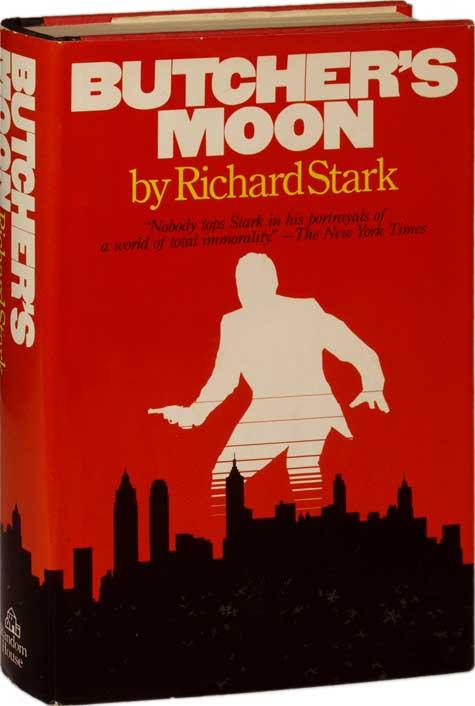
This installment of Random Readings is from Donald Westlake's 1974 novel BUTCHER'S MOON, the 16th of Westlake's novels written under the pseudonym of Richard Stark and featuring the ruthless professional thief known as Parker. MOON was the last Stark/Parker novel until 1997's COMEBACK (Parker's lived on in six books since, including the latest, ASK THE PARROT), and it's one of the best, although sadly out of print. It also contains one of the hardest-boiled passages in crime fiction, a scene (slightly edited here) that's a perfect mixture of character, action and dialogue. And, of course, in the Stark way, it seems absolutely effortless.
A little set-up: Grofield, a confederate of Parker's, has been kidnapped by mobsters who want to lure Parker into a trap and get rid of him for good. To prove they're serious, they cut off one of Grofield's fingers and have a low-level gangster named Ed Shevelly take it to Parker. Shevelly and Parker are sitting in the front seat of a stolen Mercedes, Parker at the wheel, gun in hand, when Shevelly opens the small white box he's carrying ....
Parker looked at the finger. The first knuckle was bent slightly so that the finger seemed to be calm, at ease, resting. But at the other end were small clots of dark blood and lighter smears of blood on the cotton gauze.
Shevelly said, "Your friend is alive. This is the proof."
Shevelly seemed uncomfortable now, but to be pushing himself through the scene out of some inner conviction or determination. Almost as though he had a personal grudge against Parker...
Parker glanced at the finger. "That's no proof of anything," he said.
"If you don't get to Buenadella's by noon tomorrow," Shevelly said, "they'll send you another finger. And another finger every day after that, and then toes. To prove he's still alive, and not a decomposing body." ...
Parker, studying him, saw there was no point arguing with him, and no longer possible to either trust him or make use of him. He gestured with the pistol toward Shevelly, saying "Get out of the car."
"What?"
"Just get out. Leave the door open, back away to the sidewalk, keep facing me"
Shevelly frowned. "What for?"
"I take precautions. Do it."
Puzzled, Shevelly opened the door and climbed out onto the thin grass next to the curb. He took a step to the sidewalk and turned around to face the car again.
Parker leaned far to the right, aiming the pistol out at arm's length in front of him, the line of the barrel sighted on Shevelly's head. Shevelly read his intention and suddenly thrust his hands out protectively in front of himself, shouting, "I'm only the messenger!"
"Now you're the message," Parker told him, and shot him.
- From "Butcher's Moon," copyright 1974 by Richard Stark (Donald E. Westlake)
Subscribe to:
Posts (Atom)