I came across this Charles Bukowski poem for the first time last week. As the man says, it's a beauty.
The Laughing Heart
your life is your life
don’t let it be clubbed into dank submission.
be on the watch.
there are ways out.
there is a light somewhere.
it may not be much light but
it beats the darkness.
be on the watch.
the gods will offer you chances.
know them.
take them.
you can’t beat death but
you can beat death in life, sometimes.
and the more often you learn to do it,
the more light there will be.
your life is your life.
know it while you have it.
you are marvelous
the gods wait to delight
in you.
Sunday, March 25, 2007

Monday, March 12, 2007
Charles Einstein 1926-2007

Charlie Einstein was a pro.
A veteran newsman, novelist, sportswriter and television scribe, Charlie was one of a kind. I got to know him well over the last six or so years, while serving as his editor at The Newark Star-Ledger. For as long as anyone could remember, Charlie had been writing an Atlantic City entertainment column for the paper, and was still doing it well into his late-70s. I inherited the editorship of the column in 2000, and thus began a series of weekly phone conversations with Charlie about his column, books, movies and life in general, generally punctuated with his trademark “Stop me if you’ve heard this one ...” jokes.
To me, at first, he was just the gravel-voiced, old-school columnist who turned in a short piece each week in a style that was more akin to Ed Sullivan’s “Talk of the Town” than anything that had actually appeared in a newspaper after 1950. Often our exchanges included comments along the lines of “Uh, Charlie, I think we should change this reference. I don’t know if many people these days know who Yogi Yorgesson is.”

Charlie had two half-brothers as well, from his father’s second marriage – Albert Einstein and Bob Einstein. Albert, of course, eventually became writer/director/comedian Albert Brooks, and Bob went on to cable fame as “Super Dave Osborne” and is now a regular on HBO’s “Curb Your Enthusiasm.”
Charlie would never volunteer any of this though. You had to come to those conversations already armed with background information, or the references would fly right past you. Born in Boston, Charlie attended the University of Chicago shortly after the Manhattan Project produced the first nuclear chain reaction in an underground laboratory beneath one of the school’s athletic fields (“We used to joke that our locker room was the nicest in the country,” he’d say. “But the water in the showers was radioactive.”)

In Chicago, Charlie started working for International News Service, which would eventually become part of UPI. While there he wrote his first novel, THE BLOODY SPUR, a newspaper drama/serial murderer thriller based on the crimes of “Lipstick Killer” William George Heirens, a University of Chicago student whose murder spree terrorized the city in 1945-46. The book was published as a paperback original by Dell in 1953 and the film rights were bought by Fritz Lang, who turned it into his 1956 movie WHILE THE CITY SLEEPS, starring Dana Andrews and Ida Lupino (“The producers tried to sue Andrews because he was drunk on the set all the time,” Charlie once told me. “Which is funny because he was supposed to be playing an alcoholic in the film.”)
More books followed, as well as dozens of stories for magazines such as MANHUNT and SATURN, as well as “slicks” such as HARPER’S and THE SATURDAY EVENING POST.
 But sportswriting grew to be his true love. After moving to San Francisco in the late ‘50s to work for the Examiner, he began covering the Giants and became friends with Willie Mays, a friendship that would last the rest of Charlie’s life. He co-authored Mays’ memoir “My Life in and Out of Baseball," and was the author of the oft-reprinted "Willie’s Time: Baseball’s Golden Age.” In the ‘60s, Charlie appeared in a pair of TV documentaries about Mays that were collected and updated in the recent video “Willie Mays: Born to Play Ball.”

Charlie soon became a major figure among sportswriters, and edited four volumes of the classic "Fireside Book of Baseball" series. But he continued to write fiction as well, including, in 1967, a science fiction novel for Fawcett’s landmark Gold Medal line, THE DAY NEW YORK WENT DRY, about a drought-plagued Manhattan collapsing into chaos. His editor there was an old friend, the legendary Knox Burger, whom Charlie had written for at various publications and publishing houses since the end of World War II. More than fifty years later, Burger would become my first agent. (“I always hated that title,” Charlie told me in 2001. ”My title was ‘The Day New York RAN Dry.’ Knox changed it to ‘The Day New York WENT Dry.’ Made it sound like it was about Prohibition or something.”)

Charlie soldiered on, writing a baseball column for the San Francisco Chronicle in the 1970s, and continuing to turn out novels and nonfiction works (he wrote one of the earliest TV tie-ins as well, a 1959 paperback adapting stories from television’s NAKED CITY). His 1978 novel THE BLACKJACK HIJACK became a TV movie titled NOWHERE TO RUN, starring David Janssen and Stefanie Powers. He also wrote scripts for LOU GRANT, to date one of the most accurate recreations of life in an actual metropolitan newsroom.
In semiretirement, Charlie returned to where he started, the news business. After relocating to New Jersey, he began writing that Atlantic City column for The Star-Ledger, a gig he held for nearly 20 years. The news content of the columns was minimal, the style anachronistic, but I soon discovered there was no sense in trying to alter Charlie’s voice. It was unique.
But in the last two years, he was fading and he knew it. Living alone outside Atlantic City (Corrine, his wife of 42 years, had died in 1989), he was often plagued by memory issues, his copy riddled with typos. He wasn’t ready to hang it up yet though. At the age of 75, with the aid of his sons, he bought a computer and learned how to use it, so that he could file his column electronically (for the two decades previous, he’d mailed them in, typewritten). I spent many afternoons on the phone with him, talking him through technical glitches (“I hit SEND and it says it’s sending but it’s not going anywhere!”)
But mostly I think Charlie just wanted to talk, especially to someone who knew something of his past, of who he’d been before, what he’d done. I sent him a signed copy of my first novel, THE BARBED-WIRE KISS, when it came out in 2003. In return, he autographed a first edition paperback of THE BLOODY SPUR for me. “To Wally, best among editors,” he wrote in it. “Where were you when I needed you?”
In early 2006, I got a very terse e-mail from Charlie, that was CC’d to others who knew him. He was leaving New Jersey, he wrote, at the urging of his son Mike, who wanted to bring him back to live near he and his family in Michigan City, Indiana (the picture at top, taken last April, is Charlie and his granddaughter Cayla). At first, Charlie hoped to continue the column, but that soon proved impossible. He called me a month later, after settling into his apartment at an assisted living facility. “This is a great place,” he told me. “I’ve got a nice room, a TV, my computer. But I’m locked in!” Still, he said, he was enjoying the slower pace and was catching up on his reading, including my second novel, THE HEARTBREAK LOUNGE, which I’d sent him with the inscription “Here’s my Gold Medal book ... 30 years too late.” More importantly, he told me, he’d started another novel himself.
In March 2006, I got another e-mail from him. “Wally,” it read. “One of the few pleasures of dementia is that of saving the best for last, and by last I mean writing to you. As excuses for not writing sooner go, that must rank right up there with Custer’s order not to take any prisoners, but it did give me the chance to re-read THE HEARTBREAK LOUNGE ... and where in my inscribed copy you apologize for being too late for Gold Medal, know that you weren’t too late. You just skipped the grade.
All Bests,
Charlie”
On Thursday afternoon, I came out of a story meeting to find a voicemail message waiting for me from Charlie’s other son, Jeff, Cayla's dad, telling me that his father had passed away the day before. It was followed by an e-mail from Mike. “I am sad to report that Charlie passed away yesterday afternoon at St. Anthony's Memorial Hospital in Michigan City,” it read. “His health had been steadily declining over the past year, culminating this week in the onset of pneumonia. He was admitted to the hospital yesterday morning and quickly slipped into unconsciousness from which he did not emerge. He was simply too weak to fight back any longer. He died peacefully in his sleep."
Peter Genovese wrote a fine obituary of Charlie (with comment from Willie Mays) which ran in Saturday’s Star-Ledger. It can be found here.
(UPDATE: Unfortunately, in the years since this was first written, the Genovese obit seems to have been purged from the NJO archives.)
Monday, March 05, 2007
Track Marks, Part Two

Following up on last week’s entry, here is the first installment of what I feel are some of the best – or at least most entertaining – DVD commentaries out there today, in rough alphabetical order. Comments welcome.
ANIMAL FACTORY (Columbia Tri-Star). Commentary by Danny Trejo and Eddie Bunker
Not many people saw this great Steve Buscemi-directed prison drama from 2000, though it sported a brutally authentic atmosphere and a terrific cast, including Willem Dafoe, Edward Furlong, Mickey Rourke, Seymour Cassell and the great Mark Boone Jr. The commentary adds yet another level of authenticity, coming as it does from ex-con-turned-novelist Eddie Bunker, who wrote the book it’s based on, and ex-con-turned-actor Danny Trejo, who co-stars and, with Bunker, co-produced. They were fellow convicts at San Quentin in the 1960s, and the commentary gives them a chance not only to reminisce about the day-to-day realities of prison life (“Some of the most politest people in the world are in the penitentiary,” Trejo says, “The last thing you want to do is be rude to another killer”), but also to marvel at where life took them afterward (“Boy, we come a long way, Bunk”).
Bunker, a career armed robber, sold his novel “No Beast So Fierce” to Hollywood while he was still in prison, and saw it made into the Dustin Hoffman movie STRAIGHT TIME. After his release, more novels (the best of them is 1981’s LITTLE BOY BLUE) and film roles (most notably Mr. Blue in RESERVOIR DOGS) followed. Trejo eventually became a drug counselor and served as a consultant on films such as RUNAWAY TRAIN and HEAT. He’s since become one of the busiest character actors in Hollywood, with roles in the SPY KIDS films, the new SHERRYBABY and the upcoming GRINDHOUSE. But their commentary here brings them back to another time, before Hollywood or anyone else came calling, and their futures promised only more of the same. Bunker died in 2005. His 2000 memoir, EDUCATION OF A FELON, is a classic.
Friday, March 02, 2007
And for those wondering ...
... what Dave does in his free time when he's not solving decades-old crimes or commenting on the weather, there's this from yesterday's New Orleans Times-Picayune:
N.O. BISHOP ORDAINED
At 43, Fabre is youngest in the nation
Thursday, March 01, 2007
By Bruce Nolan
A Baton Rouge parish priest became the youngest Catholic bishop in the country Wednesday in a two-hour ordination ceremony in which the Rev. Shelton Fabre was given a share of the leadership of the Archdiocese of New Orleans.
Fabre, carrying a crozier, or shepherd's staff, that once belonged to Archbishop Joseph Francis Rummel, walked around the packed interior of St. Louis Cathedral in the French Quarter absorbing applause from family, scores of New Orleans priests and about two dozen visiting bishops who participated in the ceremony.
Fabre assumes his office today, although he said in a recent interview that he, Hughes and Bishop Roger Morin have not yet decided how to divide the administrative duties of the archdiocese, which spans seven civil parishes surrounding New Orleans. Fabre will become pastor of Our Lady of the Holy Rosary Parish and will live there, although that parish's administrative duties will be handled by the Rev. David Robicheaux.
At 43, Fabre is the youngest Catholic bishop in the country and one of 10 active African-American bishops.
Sunday, February 18, 2007
Track Marks, Part One

You never know what you’ll get with DVD commentary tracks. Some are pointless recitations of the action you’re already watching; others are brilliant and insightful companion pieces. Some will keep you rapt, others will have you hitting the STOP button after five minutes.
In the Netflix era, many commentaries probably go unheard in the rush to return the disc and get another. And if you weren’t that crazy about the film the first time, why watch it again? But occasionally the commentaries are hidden gems, sometimes more compelling than the films themselves.
They can also be instructive, specifically about how certain scripts were conceived, developed and eventually filmed. In his commentary for the special edition of THE FRENCH CONNECTION, director William Friedkin refers to the film’s handful of deleted scenes as “scaffolding.” You need them during the construction of the building, he says, but once it’s built, they’re redundant.
That’s true of writing fiction as well, I think. I had Friedkin’s remarks in mind when I cut nearly 20,000 words out of THE HEARTBREAK LOUNGE before delivering it for the first time. The initial draft had a lot of backstory on the characters, which was necessary for me to know as I was writing it. But once I’d completed that draft and understood the characters more, I could mercilessly trim what wasn’t essential.
Commentaries can also be master classes on the film in question, even when they’re recorded by someone not involved in the production of the film. The best example of that right now is Eddie Muller, a k a The Hardest-Working Man in Noir. Muller, who’s also the author of the novels THE DISTANCE and SHADOW BOXER, is one of the principal commentators on the Fox Film Noir series (he also co-authored the recent autobiography, “Tab Hunter Confidential: The Making of a Movie Star,” and runs the annual “Noir City” film festival in San Francisco.). Muller’s scene-specific commentary on films such as NO WAY OUT (pictured), ANGEL FACE and I WAKE UP SCREAMING are both entertaining and packed with information. Muller not only does his homework, but his enthusiasm for the films comes across as well. Often, as the final credits are rolling, you feel he still has more to say.
Over the next few days, and periodically after that, I’ll be listing (in rough alphabetical order) what I feel are some of the best – or at least most entertaining – DVD commentaries out there today. Comments and recommendations welcome.
Monday, February 12, 2007
Genius at work

Let us now praise YouTube, which allows us access to something like this, which is probably funnier than anything on Saturday Night Live in the last 20 years. The same folks are responsible for this and this.
Some other links for the week:
^ She's the high priestess of punk and a recent inductee into the Rock and Roll Hall of Fame, but Jersey girl Patti Smith is still a kid at heart. Check out this appearance on the ABC Saturday morning show "Kids Are People Too" from 1979. And she knew all the words ... or most of them at least.
^ In keeping with his practice of occasionally previewing new music on his web site, Richard Thompson has recently posted an Mp3 of his song "Dad's Gonna Kill Me," from his forthcoming album "Sweet Warrior." The "Dad" is Baghdad and the song is one of his best in years.
^ And on the same topic, if you want to get really depressed about the battle for hearts and minds in Iraq, check out this clip from a 2003 "Frontline" special.
Sunday, February 04, 2007
An eclectic musical weekend ...

... and it was. First up, on Friday night, was the great Dave Alvin and his band The Guilty Men at New York's Bowery Ballroom. Alvin, formerly of the Blasters, is one of America's great unheralded songwriters. Whether you've heard of him or not, chances are you've heard one of his songs - "Fourth of July" (recorded by X and featured on a SOPRANOS episode last season), "Marie Marie," "So Long Baby Goodbye," "Long White Cadillac," "Bus Station," "Dry River" ... the list goes on. Alvin, sharing a bill with James McMurtry and The Heartless Bastards, opened the show with an 80-minute set that included only one song (Jackson Browne's "Redneck Friend") from his latest album "West of the West," but leaned heavily on material from previous albums, including 2004's "Ashgrove." Foremost among these was his noir epic "Out of Control" ("Baby's gotta make a living/ And I don't mind waiting out in the car/ I've got some nine-millimeter muscle/ In case things go too far"), which he introduced as a "new economic blues."
I was listening to Alvin a lot while writing THE HEARTBREAK LOUNGE, and a handful of his songs - especially "Interstate City," "Abilene" and "Out in California" sort of made their way into that novel by osmosis. As a nod to Alvin, when Johnny Harrow goes to ground in a seedy Asbury Park motel in HEARTBREAK, I put him in room 503, which figures prominently in "Interstate City."
Saturday night was quite a different event: Legendary Italian film composer Ennio Morricone's first-ever U.S. performance, held at Radio City Music Hall. With a 100-piece orchestra and 100-member choir, Morricone conducted selections from his film scores over the years (he's done nearly 500), and the two-hour program featured excerpts from, among others, CINEMA PARADISO, ONCE UPON A TIME IN THE WEST, THE MISSION and, of course, THE GOOD, THE BAD AND THE UGLY.
Having had much of that music as a personal soundtrack in my head for many years, it was slightly strange to hear it in a cavernous hall like Radio City, with audience members rapturously air-conducting with closed eyes and yelling "Bravo!" at the end of every movement. In addition, the Westerns that Morricone scored for director Sergio Leone (at right with Morricone in the photo above) are so irreverent and sardonic (lots of squinting and sweating and scratching), that hearing their music performed in such a formal concert setting was odd. To have the maestro (in tux and tails) walk off-stage and return with the soprano on his arm, preparatory to her singing the coyote howl of THE GOOD, THE BAD AND THE UGLY, seemed a weird and not totally comfortable collision of worlds.
Still, it was a magic night (though a pre-concert announcement calling it "one of the greatest events in the history of New York" brought snickers from the waiting audience). Reviewer Bradley Bambarger summed the whole event up beautifully in his review for the Newark Star-Ledger, which can be found here. Morricone picks up a well-deserved honorary Oscar later this month, but why it took so long is an answer only the Academy knows.
Sunday, January 28, 2007
Arctic chills

In the dark days of winter, nothing cheers you up quite like an 800-page novel about a doomed Arctic expedition.
That's one way to look at Dan Simmons' brilliant new novel THE TERROR. Simmons, whose other novels span a variety of genres (his first book was the breakthrough horror tale, THE SONG OF KALI), has come up with an idea that, at first, seems simplicity itself. He takes as the basis of his story the true-life tale of the Franklin Expedition, an 1845 voyage by two British ships, the Erebus and The Terror, to the Arctic to explore the Northwest Passage connecting the Atlantic and Pacific oceans. The two ships had 134 men between them and supplies that would supposedly last five years. Historians surmise that with the two ships hopelessly icebound, the surviving 129 crew members set off by land in hope of finding open water or rescue by a whaling ship. All of them perished on the ice, from accident or starvation. Remains of the crew members - some showing the marks of cannibalism - were later found.
There have been many explanations for what happened to Franklin's men, one of the most plausible being that their tinned provisions were tainted and crew members were struck down with lead poisoning. In Simmons' novel, there's an even greater threat stalking the men. A savage, almost mythical, beast that lives on the ice and hunts them down one by one.
Since history tells us the expedition had no survivors, you'd think that element of suspense - who lives, who dies - would be absent from the novel. But Simmons has woven the whole thing into a compelling epic of survival and horror and courage. It's an ice-cold fever dream that draws you in deeper with each chapter, each new trial the survivors face. And though Simmons has dedicated the book to the makers of the 1951 film "The Thing," THE TERROR is no pulp thriller. It's deadly serious and deeply involving. Not only is it one of the best horror novels in years, it's one of the best horror novels ever.
Sunday, January 21, 2007
Random Readings Vol. 2
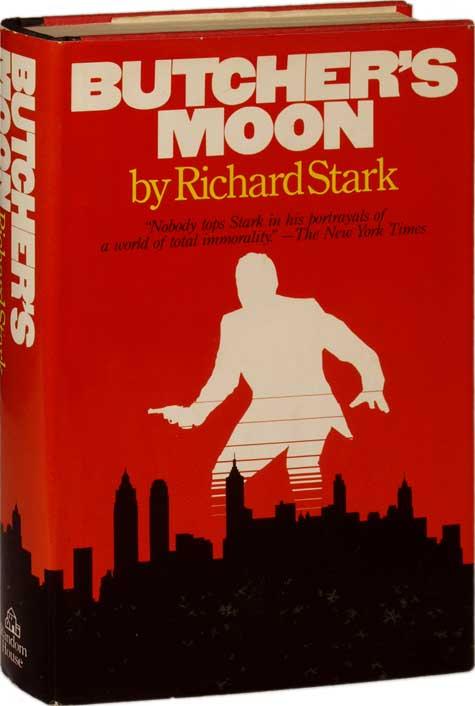
This installment of Random Readings is from Donald Westlake's 1974 novel BUTCHER'S MOON, the 16th of Westlake's novels written under the pseudonym of Richard Stark and featuring the ruthless professional thief known as Parker. MOON was the last Stark/Parker novel until 1997's COMEBACK (Parker's lived on in six books since, including the latest, ASK THE PARROT), and it's one of the best, although sadly out of print. It also contains one of the hardest-boiled passages in crime fiction, a scene (slightly edited here) that's a perfect mixture of character, action and dialogue. And, of course, in the Stark way, it seems absolutely effortless.
A little set-up: Grofield, a confederate of Parker's, has been kidnapped by mobsters who want to lure Parker into a trap and get rid of him for good. To prove they're serious, they cut off one of Grofield's fingers and have a low-level gangster named Ed Shevelly take it to Parker. Shevelly and Parker are sitting in the front seat of a stolen Mercedes, Parker at the wheel, gun in hand, when Shevelly opens the small white box he's carrying ....
Parker looked at the finger. The first knuckle was bent slightly so that the finger seemed to be calm, at ease, resting. But at the other end were small clots of dark blood and lighter smears of blood on the cotton gauze.
Shevelly said, "Your friend is alive. This is the proof."
Shevelly seemed uncomfortable now, but to be pushing himself through the scene out of some inner conviction or determination. Almost as though he had a personal grudge against Parker...
Parker glanced at the finger. "That's no proof of anything," he said.
"If you don't get to Buenadella's by noon tomorrow," Shevelly said, "they'll send you another finger. And another finger every day after that, and then toes. To prove he's still alive, and not a decomposing body." ...
Parker, studying him, saw there was no point arguing with him, and no longer possible to either trust him or make use of him. He gestured with the pistol toward Shevelly, saying "Get out of the car."
"What?"
"Just get out. Leave the door open, back away to the sidewalk, keep facing me"
Shevelly frowned. "What for?"
"I take precautions. Do it."
Puzzled, Shevelly opened the door and climbed out onto the thin grass next to the curb. He took a step to the sidewalk and turned around to face the car again.
Parker leaned far to the right, aiming the pistol out at arm's length in front of him, the line of the barrel sighted on Shevelly's head. Shevelly read his intention and suddenly thrust his hands out protectively in front of himself, shouting, "I'm only the messenger!"
"Now you're the message," Parker told him, and shot him.
- From "Butcher's Moon," copyright 1974 by Richard Stark (Donald E. Westlake)
Sunday, January 14, 2007
Here and now
As readers of the Virtual Cocktail Party over at the Good Girls Kill for Money blog will know, in recent weeks I've been listening to a lot of Del Amitri, the Scottish band that had its biggest hit back in the '90s with the ubiquitous "Roll to Me." Despite featuring some of the best pop songwriting since Lennon/McCartney, the band - essentially the core duo of Justin Currie and Iain Harvie - dropped off the radar after the release of their last album, 2002's import only Can You Do Me Good?"
But although they've since languished without a record deal or label (Mercury dropped them after the relative failure of that last album), they haven't been idle. Chief songwriter Currie has been involved in other projects, but has also put together a solo album, "Rebound," that has regrettably yet to find a label. However, thanks to modern technology, Currie has recently posted four of his new songs to his MySpace site. Better yet, they're all terrific. And at least one of them, "If I Ever Loved You," is as great a track as Del Amitri ever recorded.
The band itself isn't quite defunct yet though, it seems. Currie and Harvie have also apparently been recording a new Del Amitri record as well, and sample tracks can be found at their site.
Sunday, January 07, 2007
Out of the past

I can't say enough good things about Megan Abbott's new novel, THE SONG IS YOU, just out this week. The follow-up to her Edgar-nominated DIE A LITTLE, it's another period noir, this one set in Hollywood in the early 1950s and revolving around the real-life disappearance of actress Jean Spangler. But Abbott's central character - and the novel's wounded hard-boiled heart - is a fictional former-journalist-turned-Hollywood-press-agent named Gil "Hop" Hopkins, whose guilt and alcoholic self-loathing plunge him first-hand into the mystery. Period L.A. noirs aren't exactly rare, but this is Abbott's world and A SONG IS YOU inhabits it fully. It's also graced with some of the best dialogue I've read anywhere in a long time.
Abbott and Edgar-winning author Theresa Schwegel are also touring together over the next month or so, including two appearances in New York this week; Tuesday at 7 p.m. at Partners & Crime in Greenwich Village, and Thursday at 6:30 p.m. at The Black Orchid Bookshop on East 81st Street between First and Second avenues.
Sunday, December 31, 2006
Tuesday, December 26, 2006
James Brown 1933-2006

The Hardest Working Man in Show Business has left the building.
James Brown - the Godfather of Soul, Mr. Dynamite, Mr. Outtasight - died Christmas Day of heart failure at a hospital in Atlanta. And we'll never see his like again.
Forget about the run-ins with the law, the years of drug abuse, the infamous mug shot. History will prove Brown one of the most influential musical figures of the 20th century. His funk-driven rhythms and sheer energy swept aside cultural and racial differences, and his performance style has influenced hundreds who came after. If you need evidence, go back and give a listen to two of the greatest live albums anyone's ever made - "Live at the Apollo, 1962" and "Live at the Apollo, 1967."
The first was recorded at a sold-out performance at the Harlem theater in October '62 and Brown paid for it with his own money - $5,700. He'd already been recording for six years at that point, and his repertoire ranged from the deep soul of "Lost Someone" and the balladry of "Try Me" to the funky rhythms of "Think," which foreshadowed where he was headed musically. The 1967 album is even better, with 19 tracks recorded in June of that year, including most of his hits, an epic version of "It's a Man's, Man's, Man's World" and a ten-minute riff on "Lost Someone." In his 1986 autobiography, written with Bruce Tucker, Brown tells how the recording of the first album was almost ruined by an elderly woman in the front rows who kept yelling "Sing it, motherfucker" near the audience mike while they were recording directly to two track.
But for a more intimate look at James Brown the man, check out the 1990 compilation "Messing with the Blues" (Polydor), which collects a series of performances from 1957-75, with Brown recording numbers from the blues, jump and jazz artists that influenced him, including Louis Jordan's "Caldonia." In a spoken word rap on the track "Like It Is, Like It Was," Brown reminisces about growing up "broke and hungry" in the Jim Crow South. "Some people tell me I should think about the good things ... but believe me, it weren't that good. At least you got a right today to say you don't dig it. If we had said we didn't dig it, we'd been dead. I don't blame nobody, 'cause ignorance get everybody. But it make you want to sing the blues ..."
Monday, November 13, 2006
Tuesday, November 07, 2006
Daniel Craig IS James Bond

Confession: I haven't seen a recent James Bond film in about ten years, and I haven't seen one I've liked much in almost twice that. However, I have now seen the newest Bond film, CASINO ROYALE, and I'm here to say what I'm sure others will be saying before long:
Daniel Craig is the best Bond since Sean Connery.
I'm not really going out on a limb here. CASINO ROYALE is the toughest, most serious Bond film in years, and Craig inhabits it perfectly. He brings an amazing physicality to the role, along with a rough-hewn charm, sardonic humor and vibrant intelligence. There's a lot going on behind those ice-blue eyes, and never for a moment do you doubt him as a hard-edged - but still unseasoned - undercover operative for the British Secret Service. To say he breathes new life into a tired series would be an understatement. If the producers run out of ideas for new films, they should consider going back to remake some of the older non-Connery ones with Craig. Hell, even a couple of the later Connery Bonds would be better served by him.
The film itself has some of the same problems other Bond films have had. It's longish (two hours and 20 minutes), and the plot barely holds together as it hurtles along. It bears the multi-screenwriter mark of assorted showpiece scenes that seem to have been stitched together to make a whole, and some of the stunt sequences feel like they're from another film. But once the action moves to Montenegro and a high-stakes poker game (baccarat in the book), the film captures the dark heart of Ian Fleming's original novels perfectly. Danish actor Mads Mikkelsen (from Nicolas Refn's PUSHER trilogy) is terrific as Le Chiffre, "international banker to the world's terrorists," whose own life is riding on the game as much as Bond's. Eva Green (KINGDOM OF HEAVEN) is luminous as Bond's MI6 cohort and confidante, Vesper Lynd.
There's humor in the film, but almost all of it works, even while poking fun at the earlier Bond mythos. And amazingly - for the first time in years - large chunks of the original Fleming source novel are actually in the script. As readers of the book know, Bond takes some serious punishment along the way, and all of it - and more - is in the film.
But the real revelation here is Craig, who seems equally at home at a gambling table sporting a dinner jacket or in a narrow stairwell squeezing the life out of an opponent with his bare hands. This is Ian Fleming's James Bond.
Monday, October 30, 2006
Cocktails and questions
I'm a little late in posting this, but I was a guest last week at the Virtual Cocktail Party over at The Good Girls Kill For Money Club site, courtesy of the lovely and talented Tasha Alexander. Pour a glass and have a look.
Wednesday, October 18, 2006
The Bad Review Revue
For those who haven't seen it yet, there is much brilliance here. Especially noteworthy is an amazing 1998 review of SPHERE by my buddy Matt Zoller Seitz, which ranges from brilliant to bizarre to slightly demented. Enjoy.
Sunday, September 24, 2006
Up on THE WIRE

Let us now praise THE WIRE.
Many have done it before me, I know, especially in the three weeks since Season Four premiered. But now that I’ve seen the entire fourth season - courtesy of the folks at HBO - I feel the need to weigh in as well.
It is, quite simply, the best crime drama in the history of television.
That’s a bold statement, I know, and last season I may not have made it, exceptional as most of that season was. But this one is even better - deeper, darker and richer than those that came before.
Why is it so great? There are a lot of reasons - the sharp writing, the uniformly terrific performances, the broad scope of narrative that takes a microcosm (West Baltimore drug neighborhoods) and makes it a metaphor for society as a whole. But mainly I think it’s the planning. Unlike recent seasons of THE SOPRANOS - and this season of DEADWOOD - in THE WIRE, everything pays off. It strikes that perfect balance between the surprising and the inevitable.
As anyone who’s been watching knows, this season focuses on four eighth-graders at the fictional Edward J. Tilghman Middle School - (above, from left) Duquan (Jermaine Crawford), Randy (Maestro Harrell), Michael (Tristan Wilds) and Namond (Julito McCullum). They’re corner kids, already immersed in the street life they see around them, with few if any support systems to guide them. How they cope with their environment - and the unreasonable demands it makes upon them - is what forms the heart of the story.
Based on co-creator (and former Baltimore detective) Ed Burns’ seven years teaching in the Baltimore school system, this season is full of the kind of details only an insider could provide – like boxes of brand-new math textbooks left to gather dust in basements. His alter ego here is former Major Crimes Unit member Roland “Prez” Pryzbylewski (Jim True-Frost), who’s become a teacher after leaving the force following the accidental shooting of a fellow cop.
His unit carries on without him, but out on the street, things have changed as well. Drug lord Avon Barksdale (Wood Harris), who dominated Seasons One and Three, is nowhere in sight. He’s back in prison and losing what little influence he has left in the outside world. His ambitious lieutenant Stringer Bell (Idris Elba), who envisioned a brave new – and lucrative – world of semi-legality, ended up shot to death in Season Three’s penultimate episode. At the start of Season Four, the Barksdale organization is a shambles, with advisor Slim Charles (Anwan Glover) now working for uber-dealer Proposition Joe (Robert F. Chew), and loyal soldier Bodie Broadus (the great JD Williams) the last man standing.
In this vacuum, some of the characters introduced last season come to the fore, especially the ruthless boy king Marlo Stanfield (Jaime Hector) and his genuinely frightening henchman Chris Partlow (Gbenga Akinnagbe), whose killer’s glare is only made creepier by the intelligence in his eyes.
The writers - including Burns, co-creator David Simon, Richard Price, George Pelecanos and others - have expertly kept all the surviving main characters from Season Three in play, without making any of their appearances seem gratuitous, although a newly clean and sober Jimmy McNulty (Dominic West) does keep an inordinately low profile. Even more, they’ve effortlessly blended them into the new storyline, with maverick cop Bunny Colvin (Robert Wisdom) now co-running a pilot program in the schools. Prez and Colvin’s attempts to reach out to their charges are just as compelling as the underworld drama being played out on the city’s streets.
Make no mistake, it isn’t all doom and gloom in the world of THE WIRE. This is also the funniest season yet, with most of the best lines going to the Bunk (Wendell Pierce) and his own peculiar brand of homo-erotic cop humor. It’s also the most accessible season so far. You don’t need a lot of backstory to follow what’s going on, and the complexities of the plot are relatively easy to absorb. There’s a little more soapboxing this season - not surprising, given the topic - but it never interferes with the story.
Where most crime dramas skate away from the consequences of violent acts, THE WIRE is all about the consequences. And there are consequences aplenty before the final heartbreaking episode. Ultimately, it’s about how adults fail children, and how systems fail people - whether those systems are police departments, school districts or drug gangs. But although THE WIRE may be tough, real and occasionally brutal, it’s never cynical. It’s full of hope, even if it sometimes watches unblinkingly as individual hopes flutter out. Crime drama – and crime writing – doesn’t get any better than this.
Thursday, August 31, 2006
Random Readings Vol. 1
This week’s entry is a metaphysical musing from William Peter Blatty’s long-out-of-print 1966 novel TWINKLE, TWINKLE, ‘KILLER’ KANE. It’s a conversation between two men at an insane asylum being used to house shell-shocked war veterans. Read and discuss:
“Do you really believe in an afterlife?”
“Yes....”
“Tell me why.”
“Because every man who has ever lived has been born with desire for perfect happiness. But unless there is an afterlife, fulfillment of this desire is a patent impossibility. Perfect happiness, in order to be perfect, must carry with it the assurance that the happiness won’t cease; that it will not be snatched away. But no one has ever had such assurance; the mere fact of death serves to contradict it. Yet why should Nature implant – universally – desire for something that isn’t attainable? I can think of no more than two answers: either Nature is consistently mad and perverse, or after this life there’s another; a life where this universal desire for perfect happiness can be fulfilled. But nowhere else in creation does Nature exhibit this kind of perversity; not when it comes to a basic drive. An eye is always for seeing and an ear is always for hearing. And any universal craving – that is, a craving without exception – has to be capable of fulfillment. It can’t be fulfilled here; so it’s fulfilled, I think, somewhere else; some time else.”
— From “Twinkle, Twinkle, ‘Killer’ Kane,” copyright 1966 by William Peter Blatty.
Sunday, July 23, 2006
More on the Mick ...
Last week, BBC Radio asked me to write a brief tribute to Mickey Spillane - in the Master's style - for their obituary program "The Last Word." The program aired on BBC4 Friday and can be found at BBC-Radio 4 - Last Word.
Subscribe to:
Posts (Atom)